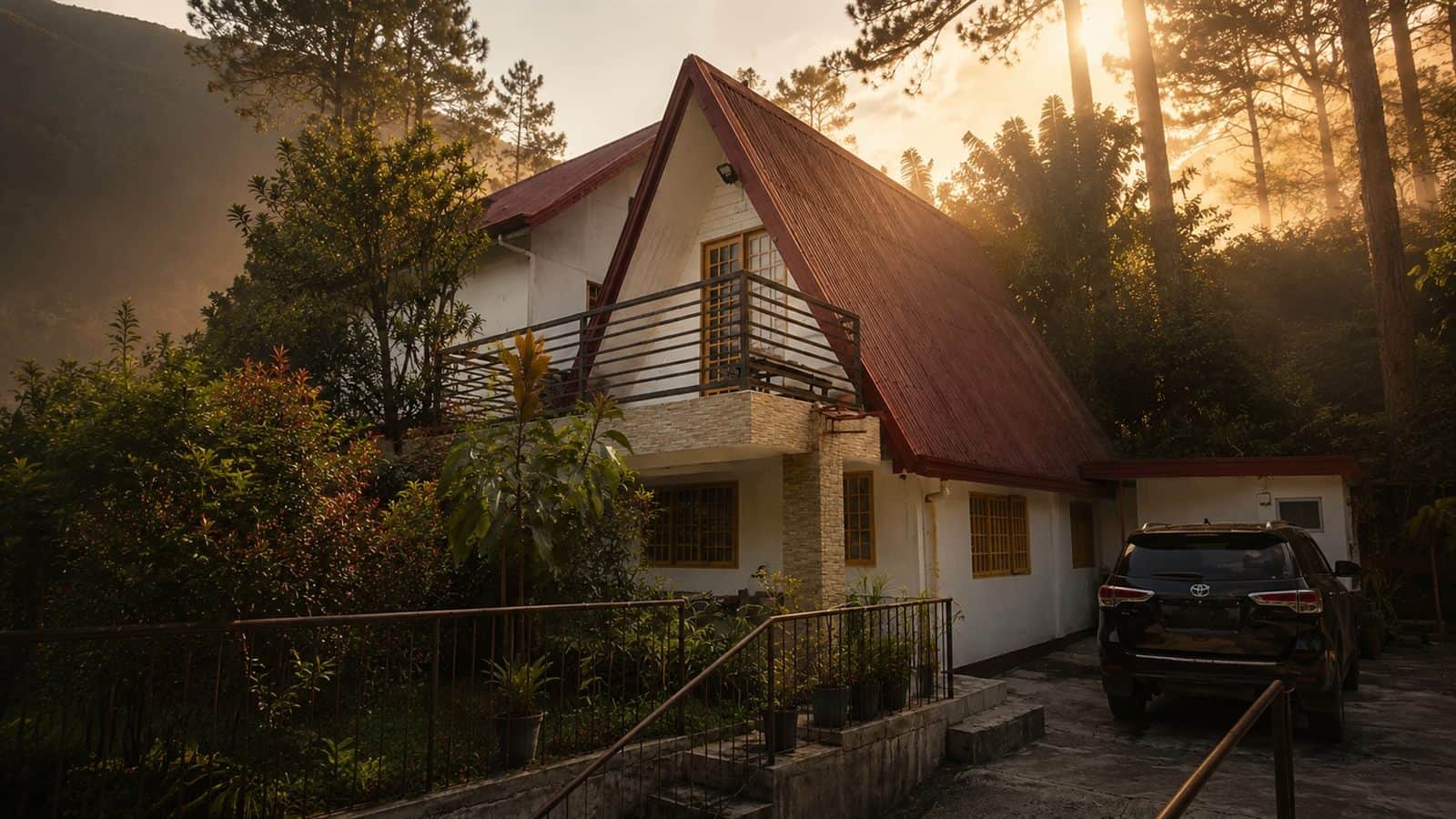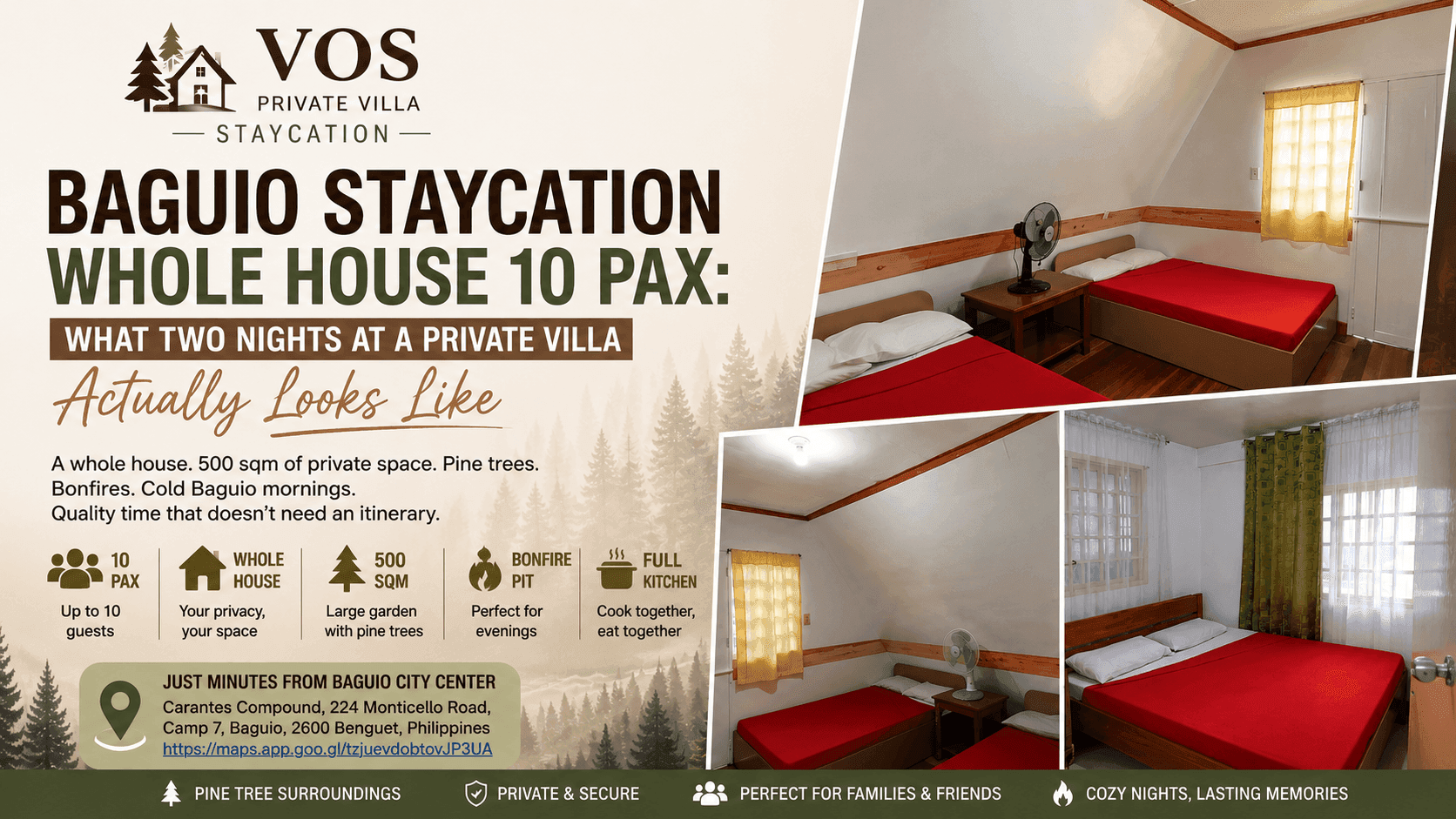
The word staycation gets used loosely. In Baguio, it means something specific: you booked the whole house, you are not racing through an itinerary, and the property itself is as much the point as any tourist spot you visit. A Baguio staycation in a whole house with 10 people is not a trip where the accommodation happens to be nice. It is a trip where the accommodation is the reason the trip works. This guide describes what that actually looks like — the rhythm of two nights, the mornings, the bonfires, the reset from Manila — and why groups that do it once tend to book again.
What a Baguio Whole House Staycation Actually Is
The difference between a Baguio staycation and a Baguio trip is where the energy goes. On a regular trip, the house is where you sleep between activities. On a staycation, the house is one of the activities. A whole-house rental with a maintained garden, a bonfire pit, a full kitchen, and 500 sqm of private space gives a group of 10 enough to do without going anywhere at all.
Most groups do go out — for a day, for half a day, for a market run. But they come back to something worth coming back to. That shift in expectation changes the whole texture of the experience. The house stops being a place to store your bags and becomes the place where the trip actually happens.
The Rhythm of Two Nights — What Actually Happens
The pattern that emerges for most 10-pax staycation groups follows a shape that nobody planned but everyone ends up following:
- Arrival afternoon — check in, walk the property, claim rooms. First-time guests spend the first 20 minutes doing slow laps of the garden. The pine trees at the back stop people mid-conversation.
- Afternoon and early evening — the group heads out. Burnham Park, Session Road, Satellite Market for ingredients, Mines View for photos. Somewhere. It does not matter much where.
- Night — everyone is back. The bonfire is going. The garden becomes the room for the evening. Drinks, food, conversation that runs past the music curfew and turns into something quieter and better. Cold Baguio air. Nobody wants to be inside.
- Morning — coffee. Pine trees. People scattered across 500 sqm of private property in ones and twos, doing nothing specific with no particular urgency. This is the part nobody planned and everyone remembers.
- Second day — repeat, in whatever order the group decides. Some go out again. Some stay. Both are the right answer.
That rhythm — one day moving, one evening still, mornings at their own pace — is what makes a two-night whole house staycation in Baguio feel longer and more restoring than the calendar says it was.
The Morning That Changes Everything
The Baguio whole house staycation morning is hard to describe to someone who has not had one. You wake up in a cold room. The pine trees behind the property are visible from wherever you are standing. The garden is quiet. Someone has already started coffee. People appear gradually — not rushing, not coordinating, just settling into the morning at their own pace across a private 500 sqm compound.
There is no checkout pressure until noon. There is nowhere you have to be yet. For a group that drove up from Manila — where mornings are commutes, noise, and urgency — this specific hour tends to be the one people mention first when you ask how the trip was. Not the bonfire. Not the tourist spots. The morning in the garden with cold air and nowhere to be.
The Manila-to-Baguio Reset — Why the Cold Matters
Manila is loud, dense, and fast. It does not pause for anyone. Baguio does — or at least, Camp 7 does. The transition that guests describe when they arrive at a private whole house after a five-hour drive from the city is not just about temperature, though the cold is part of it. It is the quiet. The space. The pine trees visible from the property. The fact that the most urgent thing happening in the compound is someone deciding where to sit.
Groups from Manila who have not left the metro in months feel the shift almost immediately upon arrival. The house gives them somewhere for that shift to actually land — not a hotel room with four walls, not a resort lobby with a hundred other guests, but a whole private property that is theirs to decompress in. That is what a Baguio staycation at this scale is actually selling, even if the listing just says bedrooms and bonfire.
Why It Works So Well for Teams and Families
A Baguio whole house staycation functions as natural team building and family reunion infrastructure without requiring anyone to plan a formal agenda. The space does it on its own. When 10 people share a kitchen, sit around a bonfire, and wake up in the same compound two mornings in a row, the connection happens without scheduling it.
Corporate groups that arrive calling it a 'team building' often end up spending most of their time just inhabiting the same space — cooking together, talking in the garden, doing nothing structured — and that turns out to be exactly what they needed. Family groups find that the shared kitchen and the communal dinner around the bonfire does more for the reunion than any planned activity could have. The house creates the conditions. The group fills them.
The Bonfire — Where the Actual Conversations Happen
In a hotel, the evening ends when the group splits to separate rooms. In a whole house with a garden and a bonfire pit, the evening continues as long as the group chooses. The bonfire at a Baguio whole house staycation is not just an amenity on a checklist — it is the room where the best conversations of the trip happen.
Baguio at night — 16°C to 19°C in the cooler months — makes sitting outside around a fire not just pleasant but necessary. The cold pulls people closer. The music curfew at 10PM removes the option of drowning conversation in speakers, which turns out to improve the evening rather than cut it short. Groups that arrived as coworkers on a company event or as a family doing an obligatory reunion leave as something slightly different. The bonfire does that reliably.
"They said they enjoyed every second. It was like they didn't want to go home — but they had work. What else can you do?" — Host, on what repeat guests say every time
Why Baguio Over a Beach Villa or a City Airbnb
A beach villa in Batangas is warm, crowded on long weekends, and dependent entirely on the weather. A city Airbnb near a mall gives you proximity to delivery apps and noise and not much else. Baguio with a whole house in Camp 7 gives you pine trees visible from the property, a bonfire that means something because the cold makes it necessary, and a residential neighbourhood that genuinely feels removed from everything without actually being far from anything.
Camp 7 is not the part of Baguio with souvenir stalls and tour bus convoys. It is the part where people live — quiet streets, functioning neighbourhood, real Baguio. That distinction is what makes a staycation there feel like an actual break rather than a change of scenery. The pine trees help. The bonfire helps. The fact that it is a whole private house with parking for your cars and no strangers sharing the space — that is what makes it work.
Loyal Guests — Why the Same Groups Come Back Every Year
The most reliable signal that a staycation works is not the first booking. It is the one after that. The villa has loyal guests who return year after year — the same barkada group, the same family batch, the same corporate team that discovered something on their first stay that they have not been able to replicate elsewhere.
When groups become regulars, the staycation stops being a trip and becomes a tradition. The same dates, the same house, the same garden and the same bonfire — but a different year and a different version of the same group. That is a category of experience that no hotel booking ever becomes. It requires a space that feels like yours each time you return to it. A whole private house in Camp 7, Baguio does that.
What to Bring — The Honest Don't-Overthink-It List
Most groups that overthink the packing list for a whole house staycation end up not using half of what they brought. The house handles more than most people expect. The kitchen package (₱300 one-time) covers everything needed to cook for 10 — gas stove, refrigerator, rice cooker, pots, pans, plates, utensils. Satellite Market and Mary Mart are walking distance for fresh produce and drinks. 7-Eleven is there for what you forgot.
- Food prep and ingredients — plan one big group meal, everything else can be sourced nearby
- Firewood for the bonfire — not provided, available at stores near the property
- A speaker for the garden (music curfew at 10PM)
- Comfortable clothes for cold mornings — the temperature drops significantly overnight
- That is genuinely most of it
Pricing and How to Book
Weekday rate: ₱5,500 for 10 pax (₱550 per person). Weekend and holiday rate: ₱6,500 for 10 pax (₱650 per person). Additional guests beyond 10 are ₱500 per head on weekdays and ₱600 on weekends. Kitchen add-on: ₱300. Down payment of 30% secures the date — no one else can take it once confirmed. Balance is paid on check-in via GCash, BPI bank transfer, or cash.
Baguio whole house staycations on holiday weekends and long weekends fill fast. If your group is planning around Holy Week, Christmas, or a national long weekend, start the booking conversation as early as your group can confirm the dates. Message directly on Facebook Messenger, WhatsApp +63 916 607 7310, or call +63 916 607 7310. Responses are fast — you talk to the host, not a system.
A Baguio staycation in a whole house with 10 pax is one of those trips that is easier to feel than to plan. The house handles most of it. The cold handles the mood. The bonfire handles the night. Your group handles everything else — which turns out to be the right amount.